Report · Oct 2026
Telehealth Customer Acquisition Cost: 2026 Report
Published
Telehealth companies spend heavily on advertising to find new patients online, and what they pay for each new customer differs widely from one company to the next. So we looked at how far apart they are and whether the cost is rising.
Our analysts studied six publicly traded virtual care companies: Hims & Hers, Teladoc Health's BetterHelp segment, LifeMD, Talkspace, Hinge Health and Omada Health. We used each company's Form 10-K for fiscal 2025, as filed by October 8, 2026. A company that spends $10 million and ends the year with 10,000 more customers has a cost of $1,000 per net new customer. Across the five companies with customer growth, the median in 2025 was $1,624, at LifeMD, and the range ran from $287 at Omada Health to $3,260 at Hims & Hers.
In the following sections, we compare costs by company, look at paid advertising and the change since 2024, and set marketing spend against revenue.
Telehealth Customer Acquisition Cost by Company, 2025
Telehealth companies spend heavily to find patients online, and dividing that spending by the customers each company added shows what one new customer costs. The Healthcare Industry Reviews research team compared marketing spending per new customer at six publicly traded telehealth companies for 2025.
| Company | Customer Measure | Marketing Line Used | FY2025 Marketing | Customers, 2024 | Customers, 2025 | Net Change | Marketing per Net New Customer |
|---|---|---|---|---|---|---|---|
| Omada Health | Members billed in prior 12 months | Sales and marketing | $90.0M | 572,000 | 886,000 | +314,000 | $287 |
| Hinge Health | Members | Sales and marketing | $317.0M | 532,326 | 782,890 | +250,564 | $1,265 |
| LifeMD | Active patient subscribers | Selling and marketing, continuing operations | $86.1M | 275,000 (March 2025) | 328,000 (March 2026) | +53,000 | $1,624 |
| Talkspace | Q4 unique payor members plus year-end consumer members | Sales and marketing | $53.8M | 102,900 | 129,100 | +26,200 | $2,054 |
| Hims & Hers | Subscribers | Marketing | $919.3M | 2,229,000 | 2,511,000 | +282,000 | $3,260 |
| BetterHelp (Teladoc) | Average monthly paying users | Segment advertising and marketing, excluding stock compensation | $518.5M | 410,000 (2024 average) | 390,000 (2025 average) | -20,000 | Not calculable |
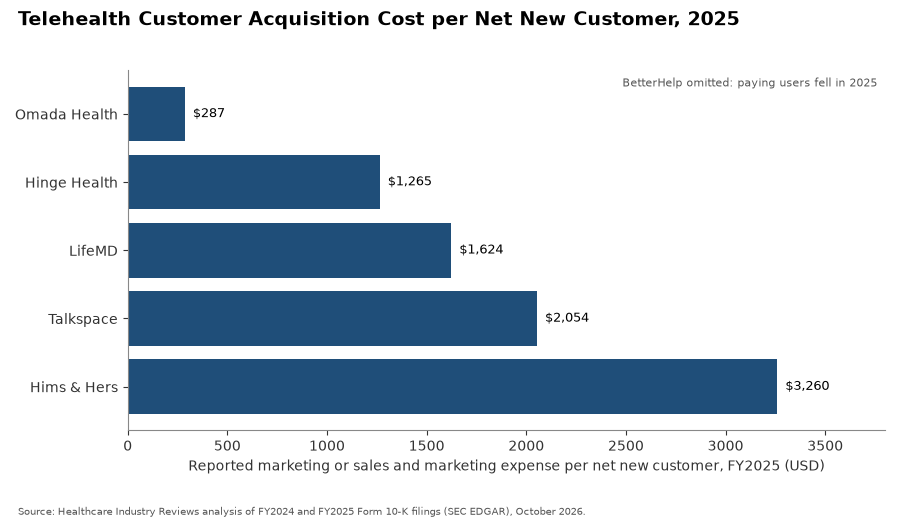
- Across the five companies with customer growth, the median marketing spend per net new customer in 2025 was $1,624, at LifeMD. The range ran from $287 at Omada Health to $3,260 at Hims & Hers.
- For telehealth companies, the cost of winning a customer varies by more than 10 times. Marketing per net new customer ran from $287 at Omada to $3,260 at Hims & Hers, with a median of $1,624. Companies selling through employers and health plans are likely to keep acquiring customers far more cheaply.
- BetterHelp spent $518.5 million on advertising and marketing in 2025 while average monthly paying users fell 5% to 390,000. That works out to $1,329 per average paying user, against $1,363 in 2024.
- Omada and Hinge sell to employers and health plans, whose employees and members then enroll. Higher channel partner administrative and marketing fees accounted for $11.9 million of Omada's 2025 increase in sales and marketing.
Telehealth Paid Advertising Cost per Net New Customer
Marketing budgets pay for staff, agencies and software as well as ads, and setting those costs aside shows what paid advertising alone costs for each new customer.
Four of the six companies also report a narrower paid advertising figure. Three of those figures can be divided by the same net customer change used above.
| Company | Advertising Figure Reported | FY2025 Advertising | Net Customer Change | Advertising per Net New Customer | Full Marketing Line per Net New Customer |
|---|---|---|---|---|---|
| Hinge Health | Advertising costs | $53.6M | +250,564 | $214 | $1,265 |
| Talkspace | Advertising costs | $30.5M | +26,200 | $1,164 | $2,054 |
| Hims & Hers | Customer acquisition costs (paid advertising and media) | $798.5M | +282,000 | $2,831 | $3,260 |
| Teladoc (consolidated) | Third-party advertising | $545.7M | Not applicable | Not calculable | Not calculable |
- Hims & Hers put 86.9% of its $919.3 million marketing line into paid advertising and media, which Hims calls customer acquisition costs. The other $120.8 million covers marketing personnel, agency, contractor and consulting fees, content production, software and other marketing operating costs.
- At Hinge Health, advertising was $53.6 million of $317.0 million in sales and marketing, or 16.9%. The rest of Hinge's line is mainly personnel costs including stock compensation, internal and third-party sales commissions, and other marketing and promotional costs.
- Most telehealth marketing money goes to paid ads at consumer brands. Hims & Hers put 86.9% of its $919.3 million marketing line into paid advertising, against 16.9% at Hinge Health. Consumer brands are likely to stay most exposed to rising ad costs.
Change in Telehealth Customer Acquisition Cost, 2024 to 2025
Setting 2025 next to 2024 shows which telehealth companies are paying more to grow and which are paying less.
Four companies report customer counts for the end of 2023, 2024 and 2025, so their cost per net new customer can be compared across two years.
| Company | FY2024 Marketing | FY2024 Net New Customers | FY2024 Cost per Net New Customer | FY2025 Marketing | FY2025 Net New Customers | FY2025 Cost per Net New Customer | Change |
|---|---|---|---|---|---|---|---|
| Hims & Hers | $678.8M | +692,000 | $981 | $919.3M | +282,000 | $3,260 | +232% |
| Hinge Health | $167.1M | +161,800 | $1,032 | $317.0M | +250,564 | $1,265 | +23% |
| Omada Health | $68.1M | +181,000 | $376 | $90.0M | +314,000 | $287 | -24% |
| Talkspace | $50.5M | +12,000 | $4,210 | $53.8M | +26,200 | $2,054 | -51% |
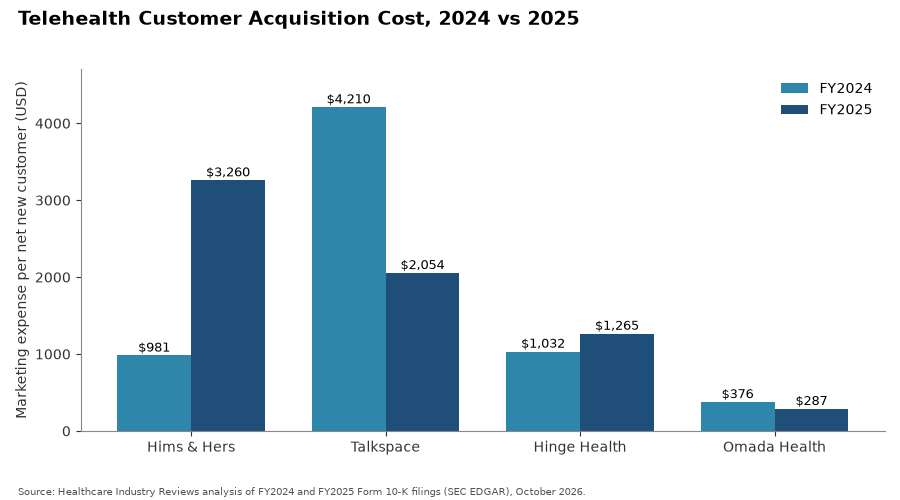
- Hims & Hers raised marketing 35% in 2025 while net subscriber additions fell from 692,000 to 282,000. Subscribers grew 12.7% in 2025 after 45.0% growth in 2024.
- Hinge Health's 2025 sales and marketing line includes $106.0 million of stock compensation, most of it tied to vesting conditions met at its IPO. On its segment measure, which excludes stock compensation, restructuring and other items, Hinge spent $207.9 million in 2025 and $164.7 million in 2024, or $830 and $1,018 per net new member.
- Omada Health's members grew 54.9% in 2025 while sales and marketing rose 32%, which brought its cost per net new member down from $376 to $287.
- Consumer telehealth growth is getting more expensive. Hims & Hers raised marketing 35% while net subscriber additions fell from 692,000 to 282,000. If this continues, more companies are likely to follow Talkspace and Omada toward employer and payor channels.
Telehealth Marketing Spend as a Share of Revenue
Marketing as a share of revenue shows how much of every dollar a telehealth company earns goes back into finding customers, which makes companies of very different sizes easy to compare.
| Company | FY2024 Revenue | FY2024 Marketing | FY2024 Share | FY2025 Revenue | FY2025 Marketing | FY2025 Share |
|---|---|---|---|---|---|---|
| BetterHelp (Teladoc) | $1,040.7M | $558.8M | 53.7% | $950.4M | $518.5M | 54.6% |
| Hinge Health | $390.4M | $167.1M | 42.8% | $587.9M | $317.0M | 53.9% |
| Hinge Health, excluding stock compensation, restructuring and other items | $390.4M | $164.7M | 42.2% | $587.9M | $207.9M | 35.4% |
| Hims & Hers | $1,476.5M | $678.8M | 46.0% | $2,347.6M | $919.3M | 39.2% |
| LifeMD (telehealth) | $154.8M | $70.1M | 45.3% | $194.1M | $86.1M | 44.4% |
| Omada Health | $169.8M | $68.1M | 40.1% | $260.2M | $90.0M | 34.6% |
| Talkspace | $187.6M | $50.5M | 26.9% | $228.9M | $53.8M | 23.5% |
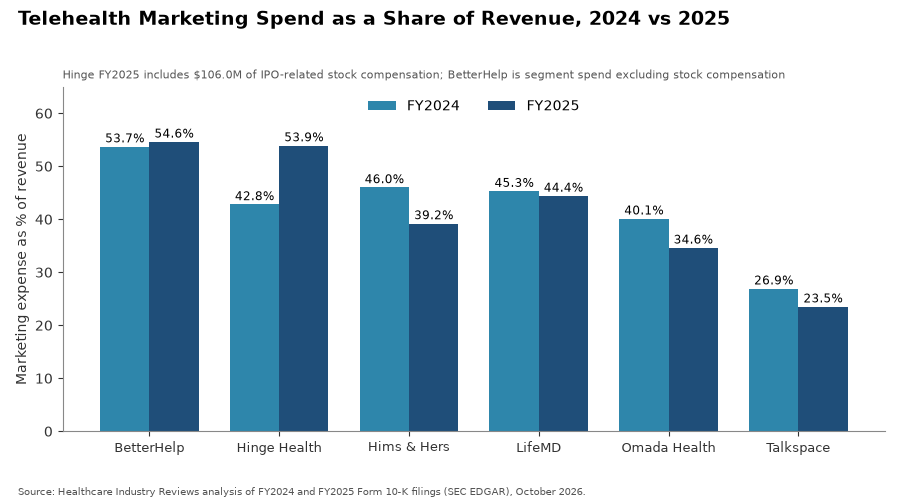
- BetterHelp spent the highest share of revenue on marketing in both years, 54.6% in 2025. Its revenue fell 9% and its marketing fell 7%.
- Talkspace had the lowest share, 23.5% in 2025. Its payor revenue rose 37.9% that year.
- Most telehealth companies are spending less of their revenue on marketing. Five of six cut their marketing share in 2025, though BetterHelp still spent 54.6%. Investors are likely to keep rewarding companies that grow without raising marketing spend.
Telehealth Revenue per Customer and Cost per Net New Customer
Setting each company's revenue per customer next to what it spends to add one gives a sense of whether a new customer pays back the cost of signing them up.
Revenue per average customer is 2025 revenue divided by the average of the start and end customer counts.
| Company | FY2025 Revenue | Average Customers | Revenue per Average Customer | Marketing per Net New Customer |
|---|---|---|---|---|
| BetterHelp (Teladoc) | $950.4M | 390,000 (average paying users) | $2,437 | Not calculable |
| Hims & Hers | $2,347.6M | 2,370,000 | $991 | $3,260 |
| Hinge Health | $587.9M | 657,608 | $894 | $1,265 |
| Omada Health | $260.2M | 729,000 | $357 | $287 |
- Hims & Hers spent $3,260 in marketing per net new subscriber against $991 of revenue per average subscriber in 2025. Its monthly revenue per average subscriber was $83.
- Omada's 2025 marketing per net new member of $287 was below its $357 of revenue per average member.
- The payback math works for some models and not others. Hims & Hers spent $3,260 per net new subscriber against $991 of annual revenue per subscriber, while Omada spent $287 against $357. Investors will likely favor models where acquisition cost stays close to a year of revenue.
What Telehealth Customer Acquisition Cost Trends Mean for 2027 and Beyond
Winning new patients through ads has become expensive for consumer telehealth companies. Companies that reach patients through employers and health plans pay far less for each new member, and some consumer brands are moving that way.
More telehealth may soon come through your employer or insurer rather than through ads. Consumer brands will need to show that their ad spending pays back faster, or cut it. That could mean fewer flashy campaigns and more services offered as part of a health plan.
So if you are looking for telehealth care, check your employer or health plan benefits first, because the same service may be covered.
Data Collection and Methodology
The six companies report customers and marketing in their own ways, and those differences affect any comparison between two of them.
The companies count customers in different ways. Hims counts subscribers who are billed automatically on a recurring basis. Hinge and Omada count enrolled members whose employer or plan pays. BetterHelp reports an annual average of monthly paying users. Talkspace reports unique payor members with a session in the fourth quarter.
Marketing lines also differ. Hims, LifeMD, Talkspace, Hinge and Omada report the full line including stock compensation. BetterHelp's segment line excludes it. Hinge and Omada sales and marketing also includes sales commissions.
LifeMD's counts of 275,000 and 328,000 subscribers come from its 10-Ks filed March 11, 2025 and March 10, 2026, each described as current. Its net change therefore covers March 2025 to March 2026, set against spending for calendar 2025. LifeMD's WorkSimpli software unit is excluded because it is reported as discontinued operations. Hims generated $134.0 million of revenue outside the US in 2025, up from $26.8 million, mainly because of geographic expansion through acquisitions. Universal Health Services completed its purchase of Talkspace on August 17, 2026, and Talkspace's shares were removed from Nasdaq, so fiscal 2025 is its last annual report.
Fiscal 2024 10-Ks were used where a 2023 or early-2025 customer count was needed. Each of the six sells care online, is or was publicly traded in the US, and reports both a marketing expense line and a customer, member or subscriber count. All six report on the calendar year.
The formula is the full marketing or sales and marketing line from the income statement divided by the change in year-end customers. None of the six discloses gross new customers, so the denominator is a net figure: customers at the end of the year minus customers at the end of the prior year. Cancellations lower that number, which makes cost per net new customer higher than cost per gross new customer. LifeMD is the one company with a usable gross proxy, the rise in the cumulative number of customers and patients it says it has served. BetterHelp is shown as marketing per average paying user because its paying users fell in 2025.
Sources
- Healthcare Industry Reviews, Telehealth Customer Acquisition Cost Study: analysis of fiscal 2024 and 2025 Form 10-K filings from six publicly traded telehealth companies, conducted October 2026.
- Hims & Hers Health annual report for 2025. Hims & Hers Health, Form 10-K, February 23, 2026.
- Teladoc Health annual report for 2025. Teladoc Health, Form 10-K, February 26, 2026.
- Teladoc Health annual report for 2024. Teladoc Health, Form 10-K, February 27, 2025. Used for BetterHelp 2023 paying users and 2024 revenue.
- LifeMD annual report for 2025. LifeMD, Form 10-K, March 10, 2026.
- LifeMD annual report for 2024. LifeMD, Form 10-K, March 11, 2025. Used for the March 2025 subscriber count and cumulative customers served.
- Talkspace annual report for 2025. Talkspace, Form 10-K, March 13, 2026.
- Talkspace annual report for 2024. Talkspace, Form 10-K, March 12, 2025. Used for 2023 member counts.
- Hinge Health annual report for 2025. Hinge Health, Form 10-K, March 3, 2026.
- Omada Health annual report for 2025. Omada Health, Form 10-K, March 6, 2026.
- Talkspace current report on completion of its merger with Universal Health Services. Talkspace, Form 8-K, August 17, 2026.