Report · Oct 2026
FDA AI Medical Device Approval Statistics: 2026 Report
Published
Many medical devices now include AI, such as software that reads X-rays and CT scans and flags urgent cases for radiologists. Before a company can sell one in the US, the FDA has to authorize it. The agency has been doing that for AI devices since the 1990s, and most of those authorizations are recent. So we counted them to see how fast the number has grown and which specialties and companies lead.
Our analysts counted every device on the FDA's public list of authorized AI-enabled medical devices, through decisions dated June 29, 2026, and sorted them by year, specialty and company. The FDA has authorized 1,614 AI-enabled medical devices, and 1,382 of them, or 85.6%, came in 2020 or later. (Move the 510(k)/De Novo/PMA definition to the review-times section or Methodology.)
In the following sections, we count approvals by year, break them down by specialty and company, measure 510(k) review times, and show where the device makers are based.
FDA AI Medical Device Approvals by Year
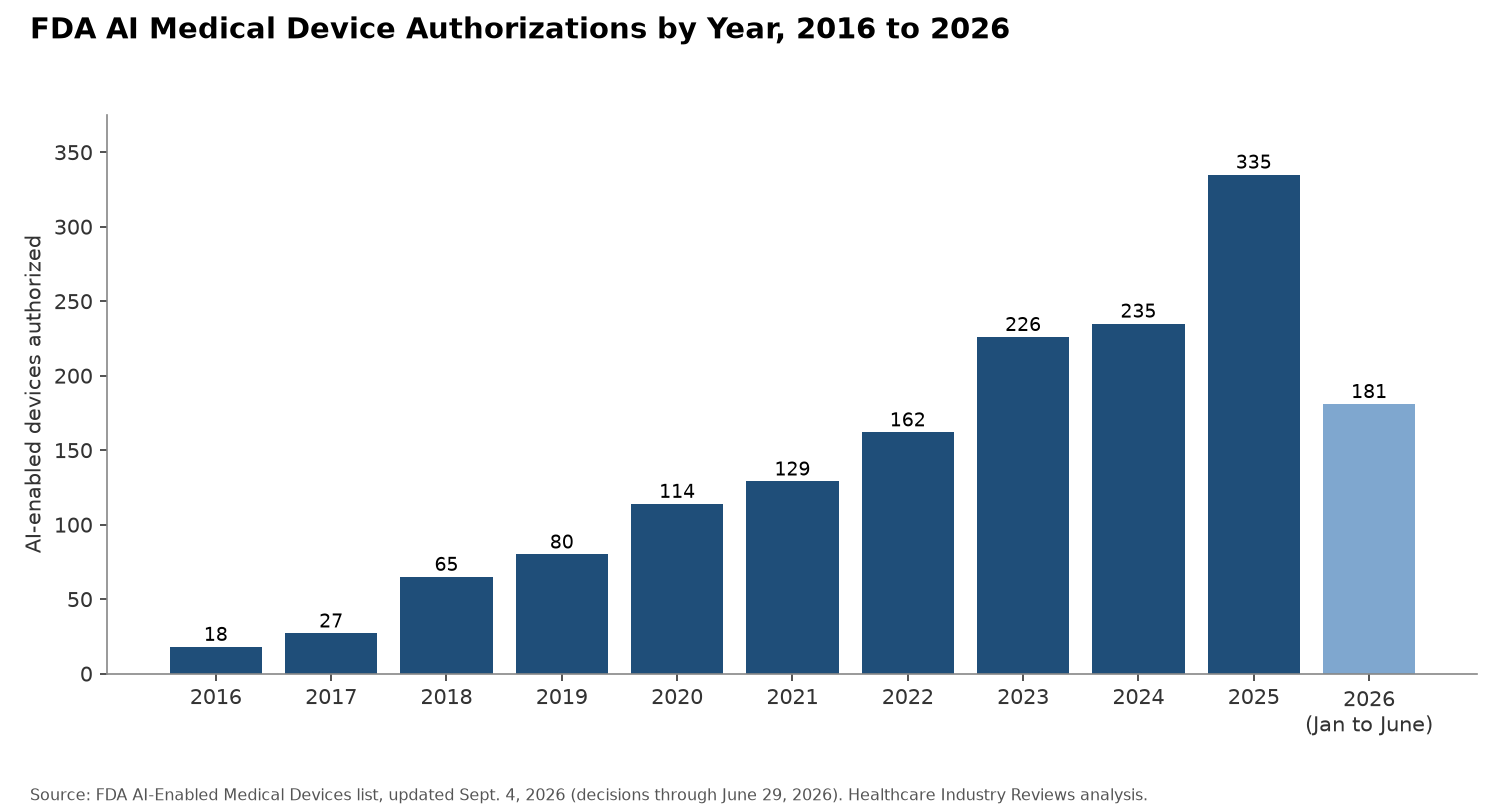
The yearly count shows how quickly AI has moved into cleared medical products. The Healthcare Industry Reviews research team counted each device by the year of its final FDA decision.
| Year | 510(k) Clearances | De Novo Grants | PMA Approvals | Total |
|---|---|---|---|---|
| 1995 to 2015 | 31 | 2 | 9 | 42 |
| 2016 | 17 | 0 | 1 | 18 |
| 2017 | 23 | 2 | 2 | 27 |
| 2018 | 58 | 7 | 0 | 65 |
| 2019 | 80 | 0 | 0 | 80 |
| 2020 | 113 | 1 | 0 | 114 |
| 2021 | 122 | 6 | 1 | 129 |
| 2022 | 160 | 1 | 1 | 162 |
| 2023 | 219 | 6 | 1 | 226 |
| 2024 | 225 | 9 | 1 | 235 |
| 2025 | 329 | 2 | 4 | 335 |
| 2026 (Jan. to June 29) | 176 | 4 | 1 | 181 |
| All years | 1,553 | 40 | 21 | 1,614 |
- The FDA authorized 335 AI-enabled devices in 2025, up 42.6% from 235 in 2024. The gain of 100 devices is the largest one-year increase on the list.
- From January through June 29, 2026, the FDA authorized 181 devices, against 173 from January through June 29, 2025, an increase of 4.6%.
- Nearly all new AI devices come through 510(k), the route for products similar to ones on the market: 329 of the 335 in 2025. De Novo grants, the route for new kinds of device, have never passed 9 in a year. Expect most future growth to come from new versions of familiar tools, not new types of product.
FDA AI Medical Devices by Specialty
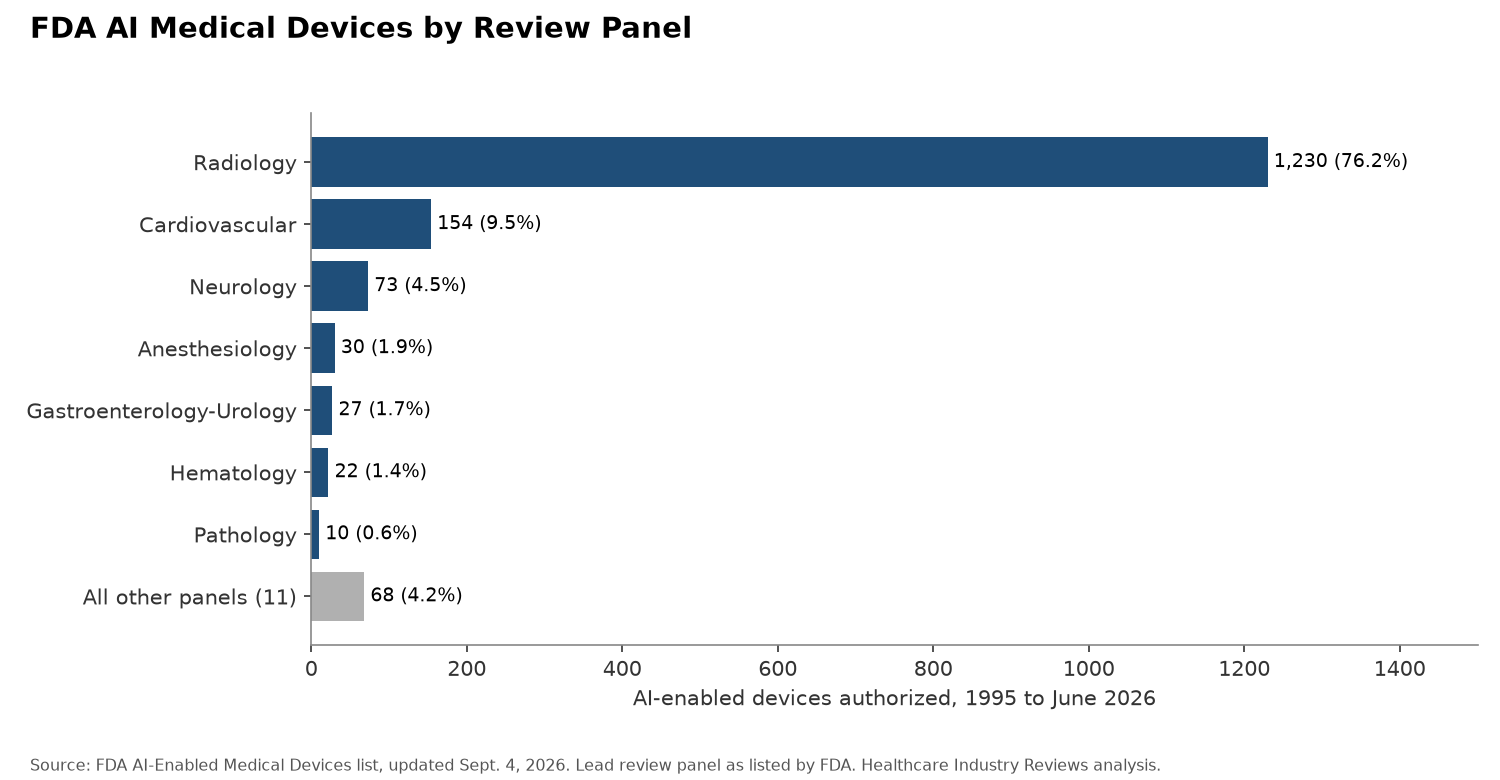
Each device on the list is assigned a lead review panel, which works as a stand-in for the medical specialty it serves. Grouping by panel shows where AI has reached clinical products and where it has barely started.
| Lead Review Panel | Devices, All Years | Share of All Devices | Devices, 2025 to June 2026 |
|---|---|---|---|
| Radiology | 1,230 | 76.2% | 389 |
| Cardiovascular | 154 | 9.5% | 45 |
| Neurology | 73 | 4.5% | 27 |
| Anesthesiology | 30 | 1.9% | 12 |
| Gastroenterology-Urology | 27 | 1.7% | 12 |
| Hematology | 22 | 1.4% | 5 |
| Pathology | 10 | 0.6% | 5 |
| Ophthalmic | 10 | 0.6% | 1 |
| Clinical Chemistry | 9 | 0.6% | 0 |
| General and Plastic Surgery | 9 | 0.6% | 4 |
| Orthopedic | 8 | 0.5% | 6 |
| Dental | 7 | 0.4% | 2 |
| Microbiology | 7 | 0.4% | 2 |
| General Hospital | 6 | 0.4% | 2 |
| Obstetrics and Gynecology | 5 | 0.3% | 3 |
| Clinical Toxicology | 5 | 0.3% | 0 |
| Ear Nose and Throat | 1 | 0.1% | 1 |
| Immunology | 1 | 0.1% | 0 |
- Radiology devices make up 1,230 of the 1,614 authorizations (76.2%). Their share since January 2025 is 75.4%, close to the all-time share.
- Cardiovascular is second at 154 devices (9.5%), followed by neurology at 73 (4.5%).
- Orthopedic devices are the fastest-growing small group: 6 of the 8 on the list were authorized in 2025 or 2026.
- Buyers outside radiology still have few authorized AI tools to choose from. Radiology holds 76.2% of all authorizations, against 9.5% for cardiovascular. If current shares hold, radiology will keep getting most new products.
Companies With the Most FDA AI Device Approvals
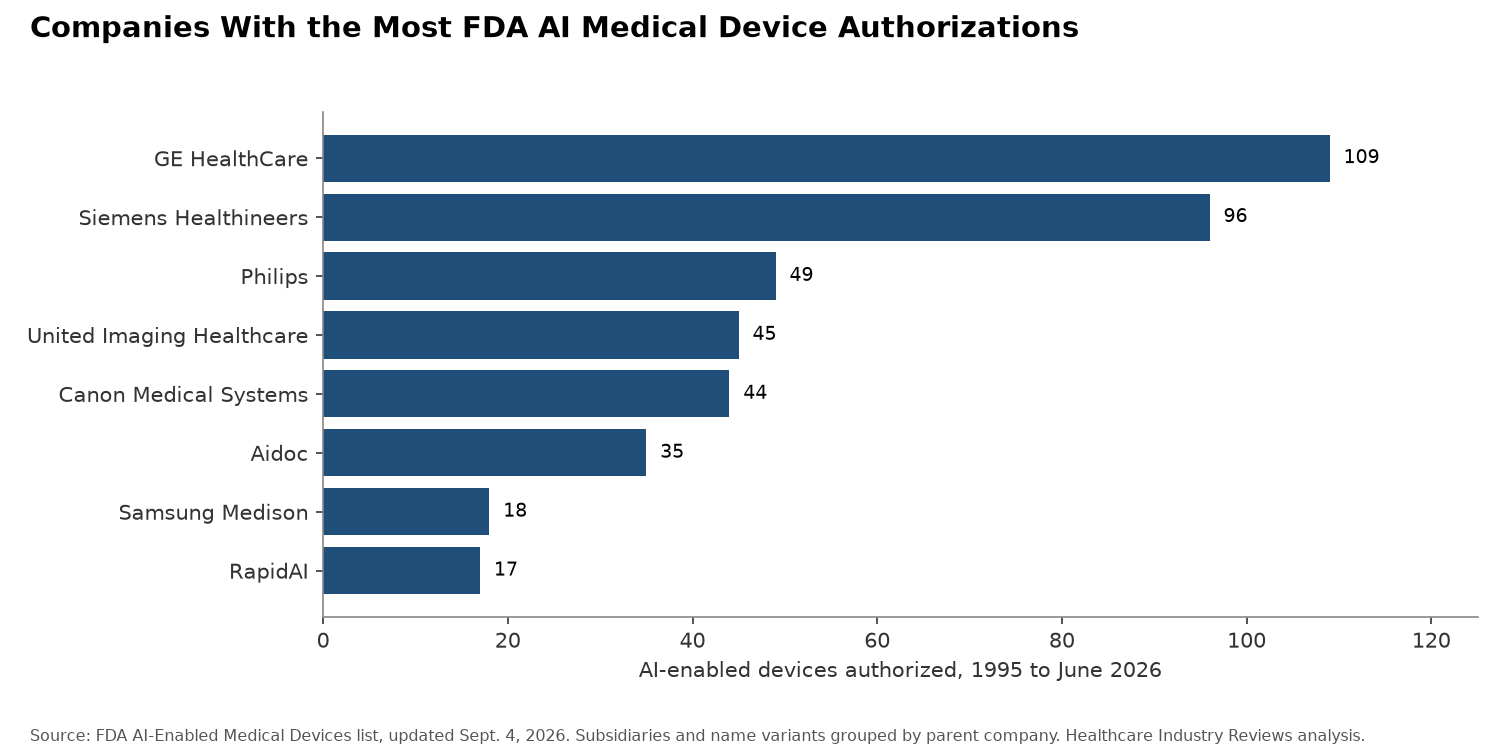
A small group of imaging manufacturers holds a large share of AI device authorizations. Subsidiaries and spelling variants on the FDA list are grouped under their parent company here.
| Company (Parent) | Devices, All Years | Devices, 2025 to June 2026 |
|---|---|---|
| GE HealthCare | 109 | 34 |
| Siemens Healthineers | 96 | 25 |
| Philips | 49 | 22 |
| United Imaging Healthcare | 45 | 19 |
| Canon Medical Systems | 44 | 12 |
| Aidoc | 35 | 7 |
| Samsung Medison | 18 | 3 |
| RapidAI (iSchemaView) | 17 | 5 |
| Fujifilm | 13 | 8 |
- The five largest imaging manufacturers (GE HealthCare, Siemens Healthineers, Philips, United Imaging Healthcare and Canon Medical Systems) hold 343 authorizations, 21.3% of the list.
- Aidoc, which sells AI triage software for radiology, has 35 authorizations, the most of any company that does not make imaging hardware.
- Hospitals that buy scanners from the big imaging makers have an easy path to AI add-ons. Those five makers hold 343 authorizations, 21.3% of the list. Independent vendors such as Aidoc, with 35, are likely to compete on breadth of conditions covered.
FDA 510(k) Review Times for AI Devices
Review time is the number of days between the date the FDA received a 510(k) submission and its decision date. Both dates come from the FDA's 510(k) database, and the figures cover the 1,553 AI devices cleared through 510(k).
| Decision Year | 510(k) Clearances | Median Days From Receipt to Decision |
|---|---|---|
| 2018 | 58 | 109 |
| 2019 | 80 | 128 |
| 2020 | 113 | 140 |
| 2021 | 122 | 118 |
| 2022 | 160 | 121 |
| 2023 | 219 | 140 |
| 2024 | 225 | 147 |
| 2025 | 329 | 141 |
| 2026 (Jan. to June 29) | 176 | 144.5 |
- The median AI device 510(k) took 136 days from receipt to clearance across all years, and 142 days for decisions from January 2025 to June 2026.
- Under its current user fee agreement, the FDA's goal is a 510(k) decision within 90 FDA days for 95% of submissions. The days counted here are calendar days and include time the clock was paused while the company answered FDA questions.
- For AI device companies, clearance takes longer than the FDA goal suggests. The median 510(k) took 142 calendar days from January 2025 to June 2026. Companies should plan for four to five months, or less through the Special 510(k) route for updates.
Where FDA AI Device Makers Are Based
The 510(k) database records the applicant's country, which shows how much of the AI device market comes from outside the US.
| Applicant Country | 510(k) Clearances, All Years | 510(k) Clearances, 2025 to June 2026 |
|---|---|---|
| United States | 710 | 210 |
| Israel | 121 | 36 |
| France | 95 | 41 |
| China | 84 | 33 |
| South Korea | 80 | 26 |
| Japan | 63 | 17 |
| Canada | 57 | 18 |
- US applicants hold 710 of the 1,553 AI device 510(k) clearances (45.7%), and 210 of the 505 cleared from January 2025 to June 2026 (41.6%).
- Israel, home to Aidoc and several other radiology AI companies, is second with 121 clearances.
- US hospitals are buying from a more international set of AI vendors. US applicants' share of clearances fell to 41.6% since January 2025, and France passed Israel in that period. That share of foreign vendors is likely to keep growing.
What FDA AI Medical Device Approval Trends Mean for 2027 and Beyond
Most AI tools the FDA has cleared are for medical imaging, and most came through the faster route for devices similar to ones on the market. That means hospitals have plenty of choice in imaging AI and far less in other areas of care.
A steadier pace of new products gives hospitals time to compare tools within a category before buying. A growing share of those tools will come from companies based outside the US, so contracts, support and service will more often involve vendors abroad. Growth outside radiology will depend on whether the FDA's process works as well for tools that do not fit the existing device categories.
So if your hospital is buying AI tools, check each product's FDA clearance and what it was cleared to do, because many tools in the same category were cleared for different uses.
Data Collection and Methodology
A device counts as authorized when it is cleared through a 510(k), granted a De Novo request or approved through premarket approval (PMA).
The figures rest on the FDA's own list of AI-enabled devices plus decision dates from its 510(k) database, and a few choices affect how they should be quoted.
We downloaded the FDA's AI-Enabled Medical Devices list, last updated September 4, 2026, with final decisions through June 29, 2026. Each device was counted once by submission number and assigned to a year by its date of final decision. The pathway comes from the submission number prefix: K for 510(k), DEN for De Novo and P for PMA. For the 1,553 510(k) devices, we matched each submission number to the FDA 510(k) database through openFDA to get the date received, the 510(k) type and the applicant country. Review time is the decision date minus the date received, in calendar days, and medians were computed from the unrounded day counts.
Company counts group subsidiaries and spelling variants on the FDA list under one parent, for example GE Medical Systems, GE Healthcare Japan and GE Hualun Medical Systems under GE HealthCare. The FDA list includes devices the agency identified as using AI, based on the device description in its public summaries. It does not cover AI tools that fall outside FDA device rules, such as many clinical decision support tools, and the FDA notes that the list is not exhaustive. Devices authorized after June 29, 2026 are not yet on the list. Because the 2026 data end on June 29, year-over-year comparisons for 2026 use January 1 through June 29 in both years: 181 devices in 2026 against 173 in 2025. The word "approval" is used loosely in this report's title: most AI devices are cleared through 510(k), and only the 21 PMA devices received approval in the FDA's formal sense. The FDA spells one panel "Clinical Toxcicology"; it is shown here as Clinical Toxicology.
Sources
- Healthcare Industry Reviews, FDA AI Medical Device Approval Study: analysis of 1,614 AI-enabled devices on the FDA list (decisions from 1995 to June 29, 2026), with 510(k) receipt dates, types and applicant countries for 1,553 devices, conducted October 2026.
- U.S. Food and Drug Administration, Artificial Intelligence-Enabled Medical Devices (list updated Sept. 4, 2026)
- U.S. Food and Drug Administration, AI-Enabled Medical Devices list download
- openFDA, Device 510(k) API
- U.S. Food and Drug Administration, 510(k) Premarket Notification database
- U.S. Food and Drug Administration, MDUFA V Performance Goals and Procedures, Fiscal Years 2023 Through 2027
- U.S. Food and Drug Administration, The Special 510(k) Program guidance